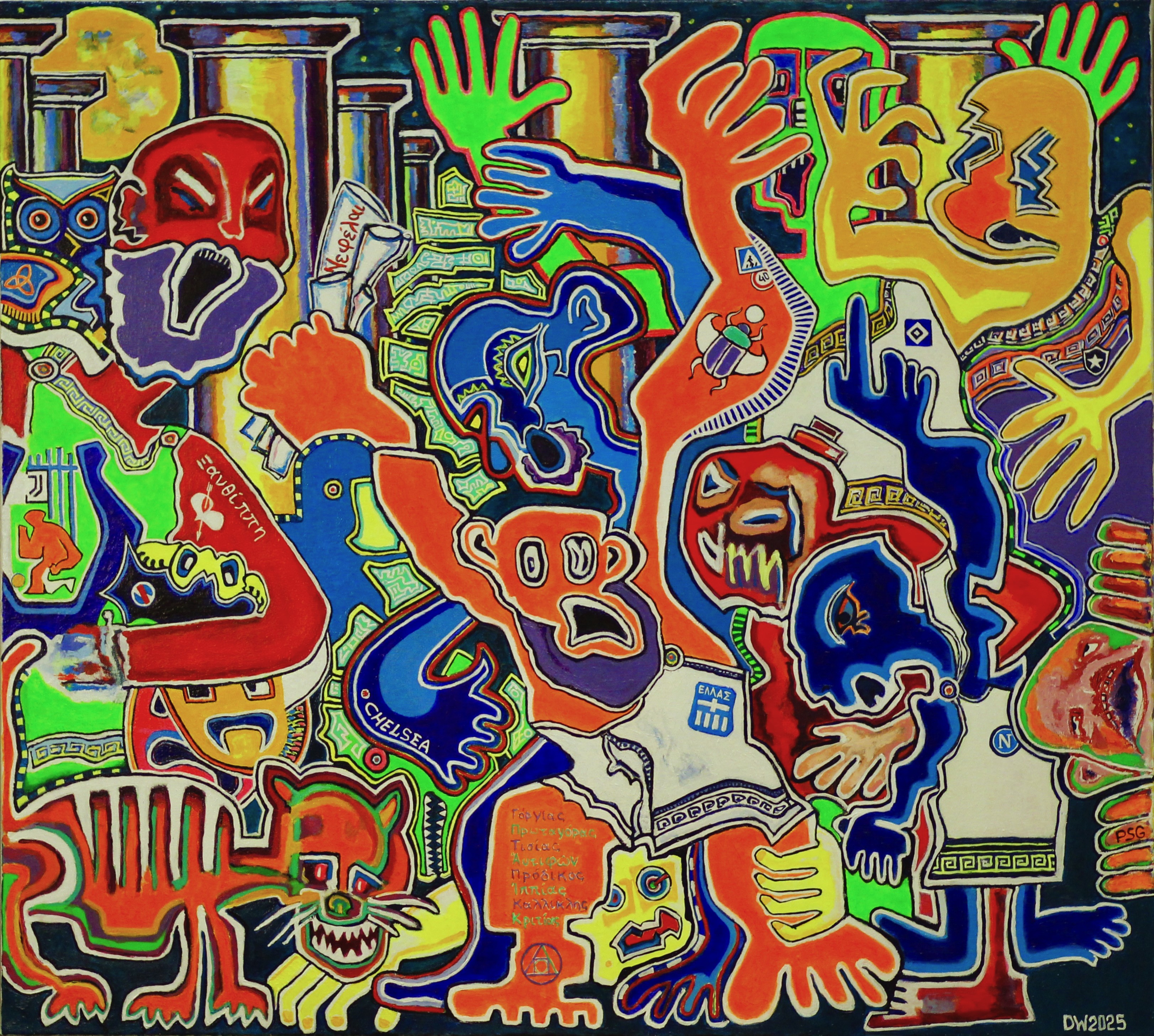
Confrontation: Socrates and Schrödinger's Cat vs. the Sophists and Nietzsche
In this work, the author attempts to find an answer for themselves to the question: «Dionysus or Apollo, or when and where did humanity take the wrong turn?»
Depicted here are:
-
the dispute between Socrates and the Sophists, of whom there are eight in the painting, namely Gorgias, Protagoras, Tisias, Critias, Hippias, etc. (the full list in Greek is provided on Gorgias's thigh);
-
the indirect dispute between Nietzsche and Socrates, from The Birth of Tragedy, symbolized by the lyre next to Socrates, to Twilight of the Idols, or How to Philosophize with a Hammer (hammer provided);
-
the dispute between Socrates and Aristophanes, in which the latter seems to side with Nietzsche – «Socrates corrupted the youth of Athens!» (in the painting, Gorgias holds a scroll with Aristophanes' comedy The Clouds (Ancient Greek: Νεφέλαι) – that is the inscription we see on the scroll).
What else?
Where Schrödinger's Cat is in the painting, who it is, and why it is here – is obvious without explanation.
Leviathan – at the center of the painting – symbolizes a certain continuity of the dispute, alluding to «island philosophy»: Hobbes, Locke, and, of course, most importantly, Berkeley.
The owl and the duck – symbols of wisdom in the mythologies of various peoples. The scarab – a symbol of the Sun and the afterlife in Ancient Egypt (why there is a crosswalk and a speed limit sign there, I hope, needs no explanation? And, of course, the same can be said about the emblems of the most renowned football clubs on the tunics of the «players»).
Why there is a pierced heart and the name of Socrates' wife (Xanthippe) on his shoulder – this too is obvious without explanation.
…so, Dionysus or Apollo? Each viewer decides for themselves.
P.S. The bat (with the Uruguayan Air Force emblem on its wing), the yellow toad, and the triquetra on the owl's wing – are symbols/messengers of the Triune Goddess Hecate. This was unavoidable.
P.P.S.: …alas, no matter how hard I tried, I could not achieve acceptable color reproduction. In the original, the colors are clearly visible – saturated red and bright orange. On screen – alas, alas… And the green and yellow in the original are far more garish, necessary to accurately convey the concept. My apologies!
Canvas, acrylic, acrylic varnish, 100x90, 2025
…
Противостояние: Сократ и Кот Шрёдингера против софистов и Ницше
В данной работе автор пробует найти для себя ответ на вопрос: «Дионис или Апполон, или где и когда человечество свернуло не туда?».
Здесь изображено:
-
спор Сократа с софистами, коих на картине восемь, а именно Горгий, Протагор, Тисий, Критий, Гиппий и т.д. (полный список на греческом на бедре Горгия прилагается);
-
заочный спор Ницше с Сократом, от «Рождения трагедии», что нам символизирует лира у Сократа, до ««Сумерки идолов, или как философствуют молотом» (молот прилагается);
-
спор Сократа с Аристофаном, где последний, кажется, солидарен с Ницше, «Сократ развратил афинских юношей!» (на картине в руке Горгия – свиток с комедией Аристофана «Облака», др.-греч. Νεφέλαι – именно эту надпись мы видим на свитке).
Что ещё?
Где на картине Кот Шрёдингера, кто он и зачем здесь – понятно без объяснений.
Левиафан – он в центре картины – символизирует некую преемственность спора, имея в виду «островную философию»: Гоббс, Локк, и, конечно же, главное – Беркли.
Сова и утка – символы мудрости в мифологии разных народов. Скарабей – символ Солнца и загробной жизни в Древнем Египте (зачем там пешеходный переход и знак ограничения скорости, надеюсь, объяснять не надо? И, разумеется, тоже самое можно сказать об эмблемах самых именитых футбольных клубов на туниках «игроков»).
Зачем пробитое сердце и имя супруги (Ксантиппа) на плече у Сократа – это понятно тоже без объяснений.
…таки Дионис или Апплон? Каждый зритель решает сам.
P.S. Нетопырь (с эмблемой ВВС Уругвая на крыле), жёлтая жаба и Трикверт на крыле Совы - символы/посланцы Триединой Богини Гекаты. Без них тут никак.
P.P.S.: …увы, как не старалась – не удалось получить приемлемую цветопередачу. В оригинале чётко видны цвета – насыщенный красный и яркий оранжевый. На экране – увы, увы… И зеленый с жёлтым в оригинале куда более ядовиты, для точной передачи замысла. Приношу извинения!
Холст, акрил, акриловый лак, 100х90, 2025